7 minutes read
How to Keep Online and In-Store Appliance Inventory in Sync

Michael Brennecke
Client Success Manager

A customer buys a GE top-load washer from your showroom on Saturday afternoon. The salesperson completes the sale, schedules delivery, and marks the unit as sold. But there's a problem: your website doesn't know that.
The washer still appears in stock when another customer finds it online. They place an order, receive a confirmation email, and later get a phone call explaining that the appliance has already been sold.
For retailers selling both online and in-store, situations like this can happen whenever inventory changes in one place without updating everywhere else. A showroom sale is only one example. Holds, newly received inventory, returns, and product condition changes can all create the same gap.
Keeping online and in-store inventory in sync closes that gap, so employees and customers see the same accurate availability wherever they're shopping or selling.
Where Online and In-Store Inventory Fall Out of Sync
A showroom sale is one of the most obvious ways inventory can fall out of sync, but it isn't the only one. Appliance inventory changes throughout the day as products are sold, received, reserved, returned, or moved between different availability statuses. When the website and store rely on separate inventory records, each change creates another opportunity for the information to become outdated.
Consider a refrigerator that arrives with cosmetic damage. The unit may still be sellable as an open-box or scratch-and-dent product, but its condition and availability have changed from what customers originally saw online. If that change isn't reflected on the website, the online listing no longer matches the actual inventory. The same problem can happen when a floor model is sold, a customer places a deposit on a unit, or newly received inventory becomes available in the warehouse.
Keeping those changes accurate becomes even more complicated when employees have to update multiple systems. A salesperson may correctly mark an appliance as sold in the point of sale (POS), but someone still has to remember to update the website. Receiving staff may add new inventory to one system while the online quantity remains unchanged. Even when everyone follows the right process, maintaining the same inventory across separate systems leaves more room for delays and errors.
The consequences eventually reach the customer. An appliance that appears available online may already be sold or reserved, while a newly received unit may remain invisible to online shoppers. Employees also have to spend more time checking availability across systems before they can confidently tell a customer what's actually in stock.
The problem isn't simply inaccurate inventory. It's having multiple systems trying to maintain their own version of the same inventory.
When Inventory Mismatches Become a Business Problem
An inventory mismatch may begin as a small discrepancy between two systems, but its impact quickly spreads beyond the inventory count. Once inaccurate availability reaches customers or employees, it can create problems across the business.
Canceled orders and refunds
A customer may order an appliance online only to find out that it was already sold or reserved in the showroom. The retailer then has to cancel the order, issue a refund, find an alternative, or ask the customer to wait for another unit.
Less trust in online availability
If shoppers can't rely on what's shown online, they may start calling the store to confirm inventory before placing an order, defeating much of the convenience the website is supposed to provide.
Missed online sales
Inventory mismatches can work in the opposite direction, too. A newly received or returned appliance may be ready to sell while the website still shows it as unavailable, preventing online shoppers from seeing inventory they could actually buy.
More work for employees
Salespeople may need to confirm availability before closing a sale, while managers spend time investigating conflicting quantities and correcting inventory records across different systems.
More complexity as the business grows.
Adding more products, online orders, or store locations means more inventory changes to track. A process that is manageable at one location can become much harder to maintain as the operation expands.
The bigger issue isn't simply having the wrong number on a website. Inventory accuracy affects what customers can confidently buy and how much work employees have to do behind the scenes.
How Real-Time Inventory Synchronization Works
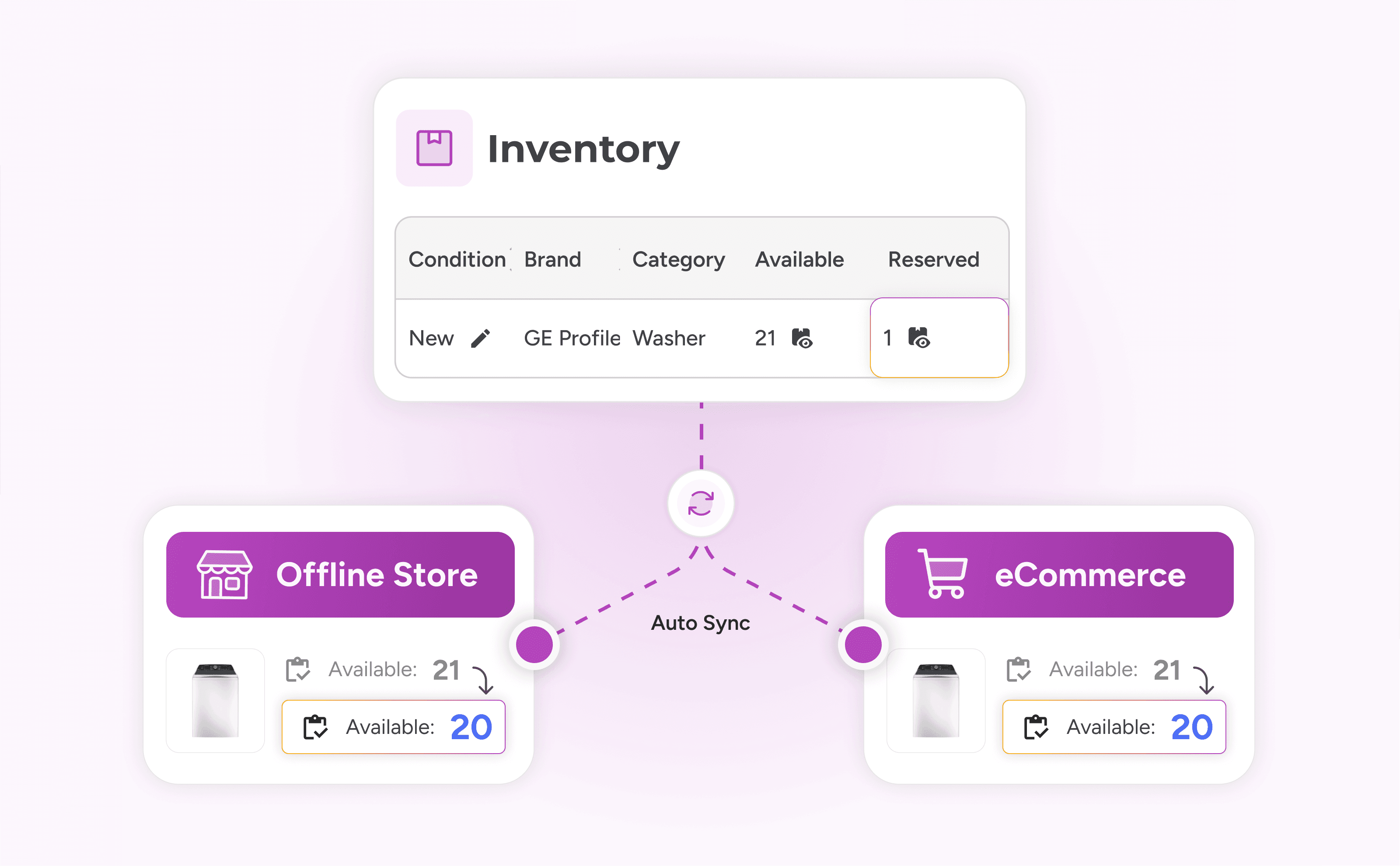
Real-time inventory synchronization keeps online and in-store availability aligned as inventory changes. Instead of employees updating the same information separately in the store and on the website, a change in inventory is recorded and reflected across the connected systems that use that data.
The process can be broken down into three steps:
An Inventory Change Happens
An appliance is sold, received, reserved, returned, or moved to a different condition or availability status.
The Inventory Record Is Updated
The change updates the appliance's current quantity, availability, condition, or status in the inventory record.
Connected Systems Reflect the Latest Inventory
The updated inventory information is reflected across connected sales channels, helping the showroom and website stay aligned without employees having to repeat the same update in multiple places.
What Your Inventory Sync System Should Handle
Keeping inventory synchronized requires more than updating quantities after a sale. The system needs to account for the different ways appliance inventory changes throughout the day, from receiving new products and reserving units to processing returns and updating product availability.
For appliance retailers selling both online and in-store, that also means connecting inventory with the systems where those changes happen. Sales from the showroom, online orders, inventory updates, and other day-to-day activities shouldn't require employees to maintain separate records just to keep availability accurate.
Appliance.io brings these workflows together on a single connected platform. Its Inventory system works with POS and the online store to keep inventory information synchronized as products are sold and managed across the business.
Ready to keep your online and in-store inventory in sync? Explore Appliance.io's Inventory or book a demo to see the platform in action.