13 minutes read
Why Appliance Retailers Need More Than a Generic Website Builder

Rocky Ahmann
Sales

Not every website builder is designed for appliance retail. While generic website builders make it easy to create a website, appliance retailers often need capabilities that go beyond pages, templates, and online checkout.
Managing appliance product catalogs, inventory, pricing, and connected retail operations requires a website that works alongside the rest of the business. Choosing the wrong platform can lead to manual work, disconnected systems, and additional complexity as the business grows.
That's why appliance retailers need more than a generic website builder. They need a platform designed to support how appliance businesses sell, manage products, and operate via an appliance eCommerce website.
Generic Website Builders vs Website Builders for Appliance Retailers
Both generic website builders and website builders designed for appliance retailers can help businesses create an online storefront. That's where the similarities begin to fade. For appliance businesses, tasks such as managing products, pricing, inventory, and daily operations require capabilities that many general-purpose website builders were not designed to support.
The following comparisons highlight key differences appliance retailers should consider when choosing a website builder.
Build a Website That Fits Your Brand Without Coding
A successful appliance eCommerce website evolves with the business. Promotions change, new brands are added, seasonal campaigns launch, and business information needs regular updates. If every website change requires a developer, even small updates can become slow, costly, and difficult to manage.
An appliance-specific website builder helps businesses take control of these everyday updates. Teams can customize pages, templates, sections, branding, widgets, and domains without coding, enabling them to publish changes faster and reduce reliance on technical support. Changes can be saved as drafts and previewed before publishing, allowing teams to review updates without affecting the live website until they're ready.
Product Catalog Management
Appliance retailers typically manage thousands of products, each with detailed specifications, images, pricing, categories, and manufacturer requirements. Keeping this information organized and accurate is essential for helping customers compare products and make informed purchasing decisions.
With many generic website builders, retailers are often responsible for manually building and maintaining their product catalog. Adding new products, updating specifications, changing pricing, replacing images, or removing discontinued models can quickly become time-consuming, especially as the catalog grows.
Website builders designed for appliance retailers better support appliance product data and retail-specific catalog management. Product information, pricing, availability, and catalog structure can be automatically prepared and synchronized, allowing retailers to launch and maintain their online storefront with far less manual setup.
Connected Business Operations
An appliance eCommerce website shouldn't operate separately from the rest of the business. Every online order affects inventory, sales, delivery scheduling, and customer service. When these systems aren't connected, retailers often have to transfer information manually between platforms, increasing the risk of delays, duplicate work, and data entry errors.
For example, a customer may purchase a refrigerator online. However, if the website isn't connected to the store's inventory, the product could still appear as available even after it has sold out. Staff may then need to verify inventory manually, update product availability, contact the customer, and coordinate changes across multiple systems. Similar manual processes often occur when updating pricing, preparing deliveries, or recording payments.
An appliance eCommerce website becomes even more valuable when it's connected to the systems that run the business. Product availability, inventory, pricing, orders, payments, and delivery information remain connected across the business, helping retailers reduce manual work while keeping website information accurate and up to date.
What to Expect from an Appliance Website Builder
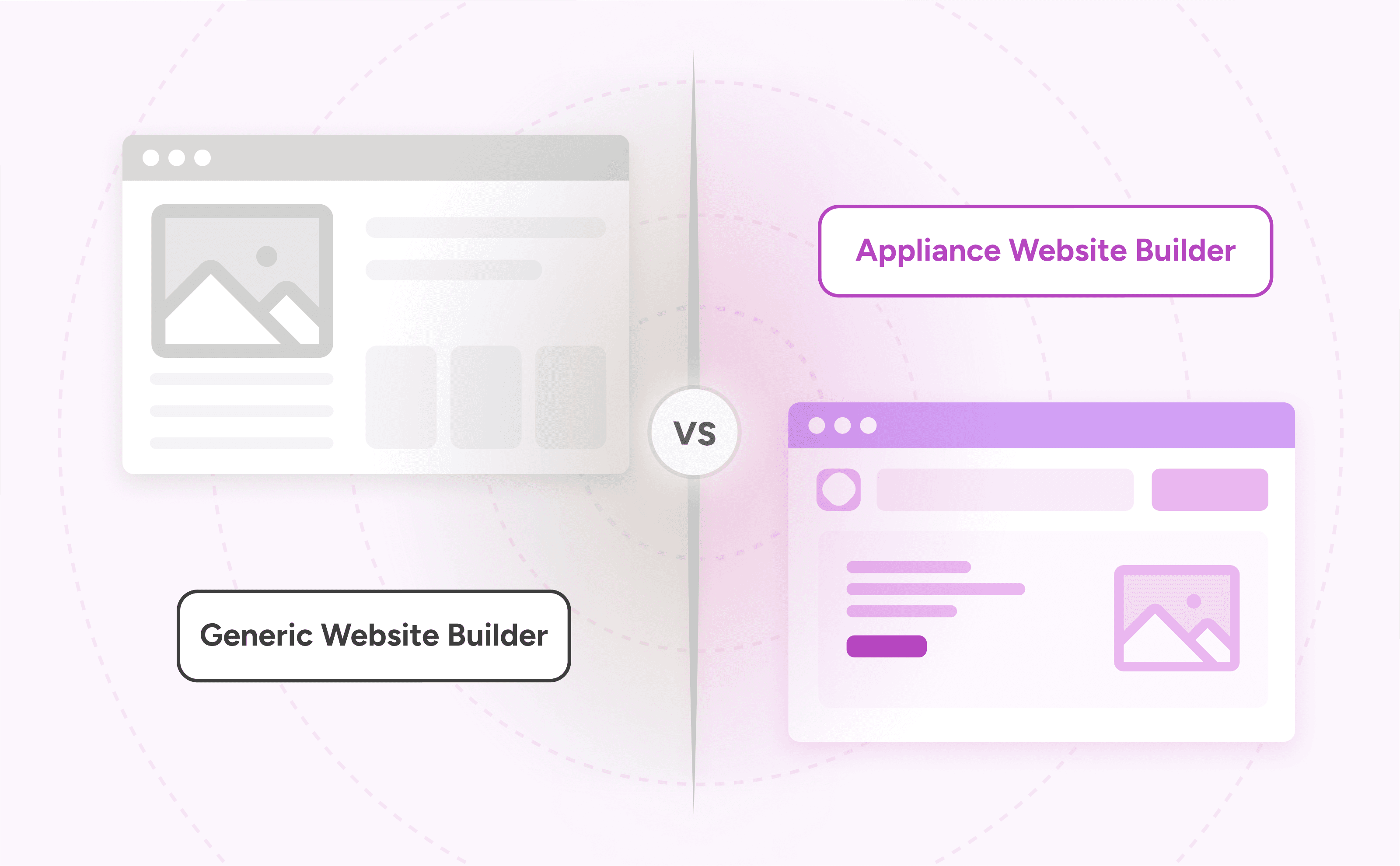
When evaluating an appliance website builder, retailers should look beyond website design and consider how well it manages products, integrates with essential tools, connects business operations, and supports long-term growth.
Integrated with Your Retail Operations
An appliance website builder simplifies daily operations by connecting the website to the systems that run the business. Rather than managing separate tools for online selling and in-store operations, retailers can keep product information, inventory, payments, and order workflows connected across the business.
Retailers can choose which brands, products, or models they want to display online without manually creating every product page or maintaining product information individually.
For example, if your store decides to feature the Bosch 800 Series B36CT80SNS on the website, your team can enable that model to appear online without manually recreating the product page or re-entering its specifications and images.
Because the website is integrated with retail operations, online selling becomes part of the same workflow as the rest of the business. Orders can flow into the Point of Sale (POS), inventory stays synchronized across the website and store, and payment information remains connected to each sale. This level of integration helps retailers maintain consistent product availability and transaction records without relying on manual updates across multiple systems.
The benefits extend beyond product and payment management. Delivery information can flow directly into Delivery Planning and the Driver App, making it easier for appliance stores to fulfill orders more efficiently. Digital Price Tags can also stay synchronized with current product and pricing information, creating a more consistent experience across both online and in-store sales channels.
Integrated with the Buying Group
Running out of stock doesn't always have to mean losing a sale. Without access to additional inventory sources, retailers may have to tell customers that a product is unavailable, even if the same model is still available elsewhere.
An appliance website builder can integrate with buying groups and inventory partners, giving retailers visibility beyond their own showroom and warehouse. The system first checks local inventory. If the product isn't available, it can check connected inventory sources, such as ADC or DMI, to see whether the item is still in stock.
For example, imagine a customer wants to purchase an LG Front Load Washing Machine, but it's no longer available at your store or in your warehouse. Instead of immediately declining the order, your team can check inventory from ADC or DMI. If the product is available through one of those connected partners, you can still accept the order and arrange fulfillment without the customer having to search for another retailer.
By extending inventory visibility beyond a retailer's own stock, buying group integration helps businesses capture more sales opportunities while reducing the need to carry every product locally.
Connected to the Tools You Already Use
An appliance website becomes even more valuable when it works alongside the tools your business already relies on. Instead of managing separate systems for marketing, product information, analytics, and other daily operations, retailers can benefit from a website that keeps information connected across multiple platforms.
For example, product data providers can help keep product specifications, images, pricing, and availability up to date across your website. Marketing and analytics tools can support online visibility while helping you understand customer behavior and website performance. Integrating these tools reduces duplicate work and helps maintain more consistent information throughout your business.
Supporting business growth becomes much easier when your website can connect with the tools already used across your retail operation.
Explore how Website Builder integrations help connect your website with the tools your business already uses.
Optimize Every Page for Search Engines
A great appliance eCommerce website is only valuable if customers can find it. While product selection and customer experience are important, retailers also need their website to appear in search engine results when shoppers are looking for appliances online.
Website builders designed for appliance retailers help support search visibility by providing page-level SEO controls. Retailers can customize meta titles, meta descriptions, URLs, schema settings, and index visibility for individual pages, giving them greater control over how their website appears in search results.
For example, retailers can optimize a product category page or create a landing page for a specific appliance brand with its own SEO settings. Giving each page its own SEO settings makes it easier for search engines to understand its content and helps potential customers discover the website more easily.
Like other website updates, SEO changes can be reviewed as drafts before being published, giving retailers greater control over when optimization updates go live.
Get Support From A Team That Understands Appliance Retail

Building an appliance eCommerce website requires more than choosing a website builder. It takes a solution that understands appliance retail workflows, product catalogs, and long-term business growth.
Appliance.io's Website Builder is designed specifically for appliance retailers, helping businesses create an online storefront that works alongside their day-to-day operations.
Book a demo to see how Website Builder can support your business and help you build an appliance eCommerce website with confidence.